
Share The Point
Related Insights

Add a Title
Add a Title
Add a Title
Risk assets rose for a second month. The US-Iran ceasefire held, oil fell from its conflict highs, and global equities advanced, led again by emerging markets and North Asian technology. Australia lagged: the RBA raised rates a third time, and the Federal Budget landed with tax changes aimed at the housing market.
International Shares (H)
+4.9%
Second strong month; IT led, up ~16%
Emerging Markets (UH)
+9.6%
North Asia tech; Korea +35%, Taiwan +16%
Australian Shares
+1.1%
Lagged again; materials led, up 10.3%
RBA Cash Rate
4.35%
Third hike of 2026; pause hinted
How asset classes performed

Source: Bloomberg. May 2026. Returns in AUD; (H) = hedged to AUD, (UH) = unhedged. Past performance is not a reliable indicator of future performance.
What happened
Australia
Australian shares rose 1.1%, again trailing global markets, following the release of the 2026 Federal Budget. Materials led the market, up 10.3% on firmer industrial metal prices, with copper rising close to 8% over the month. Consumer discretionary was the next strongest. Healthcare fell again, down 8.9% for a second month, after the United States moved to tariff imported pharmaceuticals.
The RBA raised the cash rate by 0.25% to 4.35%, its third increase of 2026 and the top of the previous tightening cycle. The market still prices a further hike this year, though the Bank hinted at a pause. The labour market softened, with unemployment rising from 4.3% to 4.5% as both full and part-time jobs fell, an early sign that prior hikes and higher fuel costs are filtering through.
The Budget proposed replacing the 50% CGT discount with an inflation-linked discount and a minimum 30% tax rate on capital gains, and removing negative gearing on established homes while retaining it for new builds. The FY2026-27 deficit is forecast at $31.5b. Government bonds returned 1.6% as the 10-year yield fell 23 basis points to around 4.83% on softer data, and listed property rose 2.9%, helped by the lower yields after a weak run.
Global
The US-Iran ceasefire held through May, with both sides working toward a longer-term agreement. Oil fell over the month as supply fears eased, and that retreat in energy prices supported risk appetite across markets. International shares (hedged) gained 4.9% in a second strong month, with information technology leading, up around 16%, and energy the main detractor as oil came off.
Emerging markets were the standout, up 9.6% on North Asian technology. South Korea rose 35.2% and Taiwan 16.4%, both carried by the semiconductor and memory cycle. US data stayed firm: growth came in near 2% annualised and equipment spending rose 17.2% annualised, including AI-related investment. Headline US inflation lifted to 4.2% over the year (core 2.9%), driven largely by energy.
Major central banks stayed on hold and kept a hawkish posture. The Fed left rates unchanged in May, in what was Jerome Powell's final meeting as Chair, and the ECB, Bank of England and Bank of Japan also held. Credit spreads narrowed in line with the risk-on tone in equities.
International Shares (H)
+4.9%
Second strong month; IT led, up ~16%
Emerging Markets (UH)
+9.6%
North Asia tech; Korea +35%, Taiwan +16%
Australian Shares
+1.1%
Lagged again; materials led, up 10.3%
RBA Cash Rate
4.35%
Third hike of 2026; pause hinted
How we see it
Capital is concentrating in a narrow set of winners across equities, credit and regions, and the gap between leaders and laggards is the widest in years. We prefer quality exposures that offer growth at reasonable risk adjusted valuations.
Our base case is constructive. US earnings are growing near 30%, powered by a productivity boom, heavy AI investment and widening margins, and that structural story is intact. The principal risk is inflation, not growth. Energy is the swing factor, and it remains so while the Strait of Hormuz is contested. A durable de-escalation would unwind energy prices and geopolitical risk premia and let cyclical assets re-rate; a higher-for-longer path would keep policy tight and leave valuations exposed to a rate hike. We are positioned for the former, and continue to monitor the latter.
The near-term catalyst is the incoming Fed Chair's first meeting, on 16 and 17 June. The market has moved from pricing cuts to pricing hikes, and the term premium is climbing off historic lows. A hawkish read would reprice growth assets, and that is the clearest risk we see today. We lean into quality growth where earnings support the price, infrastructure for inflation-protected yield, and gold and strategic commodities, and we stay selective in credit. We also treat AI as a portfolio-wide exposure rather than an equity one: the theme now runs through infrastructure, commodities, credit and digital assets, so real diversification means assessing correlation that considers today's fundamentals rather than only historical relationships.
Charts of the month
US forward earnings growth near a two-decade high
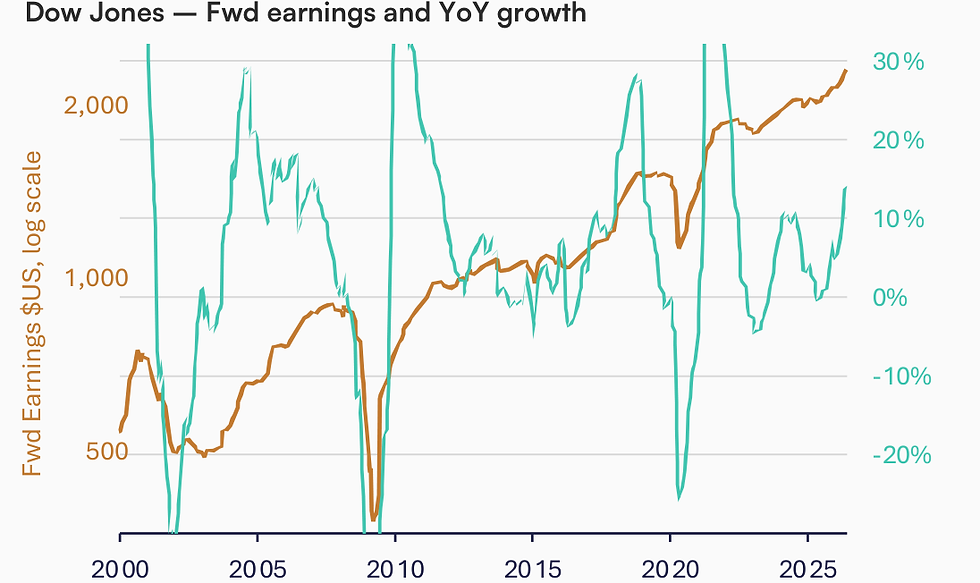
Source: Bloomberg, arcpoint.
Global bond yields elevated as term premia rise
Source: Bloomberg, arcpoint.
How we see it
The incoming Fed Chair and the path of rates. Kevin Warsh holds his first meeting on 16-17 June. Markets have swung from pricing cuts to pricing hikes, and the term premium is rising off its lows. We see a rates-led repricing as the clearest near-term risk to growth-asset valuations.
Inflation and the Strait of Hormuz. Energy is the channel through which the conflict feeds prices, and US inflation has already climbed back to 4.2% on higher energy costs. The RBA is leaning toward further tightening. Second-round effects, where producers pass costs through, are the risk we watch most closely.
AI breadth and concentration. The AI build now spans equities, power and infrastructure, strategic commodities, credit and digital assets. Emerging market returns have become, in effect, a leveraged bet on the North Asian semiconductor complex, with Korea and Taiwan now dominating the index. The concentration cuts both ways, so we manage AI exposure at the portfolio level, not just within equities.
Australia's relative position. A lack of technology and AI exposure, an RBA still raising rates, and Budget changes that act as a headwind for property leave the local market lagging global peers. Beneath the index, the gap between the largest names and the rest sits at a decade-plus extreme, so selectivity matters here too.
Gold and strategic commodities. Gold and silver pulled back through late May and into June as the hedge rotated toward oil and higher rates weighed. Our medium-term view on precious and strategic metals is unchanged, and we continue to look for opportunities to add to positions.
This document is owned by Arc Point OCIO Pty Limited, ACN 693 569 765 (APOCIO). APOCIO is a corporate authorised representative (CAR 1319046) of Capella Advisory Pty Ltd, ABN 54 669 300 163, AFSL 550125. The content in this document is provided for general information only and does not constitute personal financial product advice. It has been prepared without taking into account any person’s objectives, financial situation or needs. You should consider the appropriateness of the information in light of your circumstances and, before making any investment decision, obtain appropriate professional advice. Information contained in this document may be obtained from third party sources. While it is believed to be reliable, arcpoint OCIO has not independently verified that information and makes no representation or warranty as to its accuracy, completeness or reliability. To the extent permitted by law, arcpoint OCIO disclaims all liability arising from any error, omission or inaccuracy in the information. arcpoint OCIO does not undertake to update this information or correct any information subsequently found to be inaccurate.